Introducing ResponsePilot: The Fastest Way to Finish Security Questionnaires
If you sell into mid-market or enterprise, you've probably felt this moment.
The deal is moving. The champion is aligned. Pricing looks good. Then procurement sends over a vendor security questionnaire - usually as a dense Excel file - and everything slows down.
It's rarely just a few questions. It's 150, sometimes 300 rows covering encryption, MFA, logging, incident response, vendor risk, and data retention. Most of the questions aren't new. They're just phrased slightly differently than the last time you answered them.
And now someone on your team has to stop what they're doing to dig through old documents, previous spreadsheets, and policy files to respond.
The frustrating part isn't that security review exists. It's that the work is repetitive. The answers are already inside your organization - in your SOC 2 report, in your policies, in last quarter's questionnaire. But without a structured way to reuse them, each new spreadsheet feels like starting over.
That's the problem ResponsePilot was built to solve.
The real friction isn't compliance, it's workflow
Security questionnaires aren't technically complex. If you've implemented basic controls, you already know the answers. MFA is enforced. Logs are retained. Backups are tested. Incident response is documented.
The friction comes from assembling those answers inside someone else's spreadsheet.
Each new questionnaire triggers the same cycle:
- Search for prior responses
- Rewrite slightly different versions
- Attach supporting documentation
- Double-check for inconsistencies
- Try not to break formatting
Even when the answers are known, the process is slow and error-prone. Small inconsistencies creep in. Formatting breaks. Procurement sends follow-ups.
Over time, this becomes quiet operational drag. Sales Engineers lose hours. Founders get pulled into copy-paste work. Security leads spend more time formatting Excel than improving controls.
What ResponsePilot does
ResponsePilot starts with the spreadsheet your customer sends.
You upload the original XLSX or CSV file. The system detects questions automatically and prepares them for review - without changing the structure. No rebuilding templates. No copying into a new format.
From there, suggestions are generated using two sources:
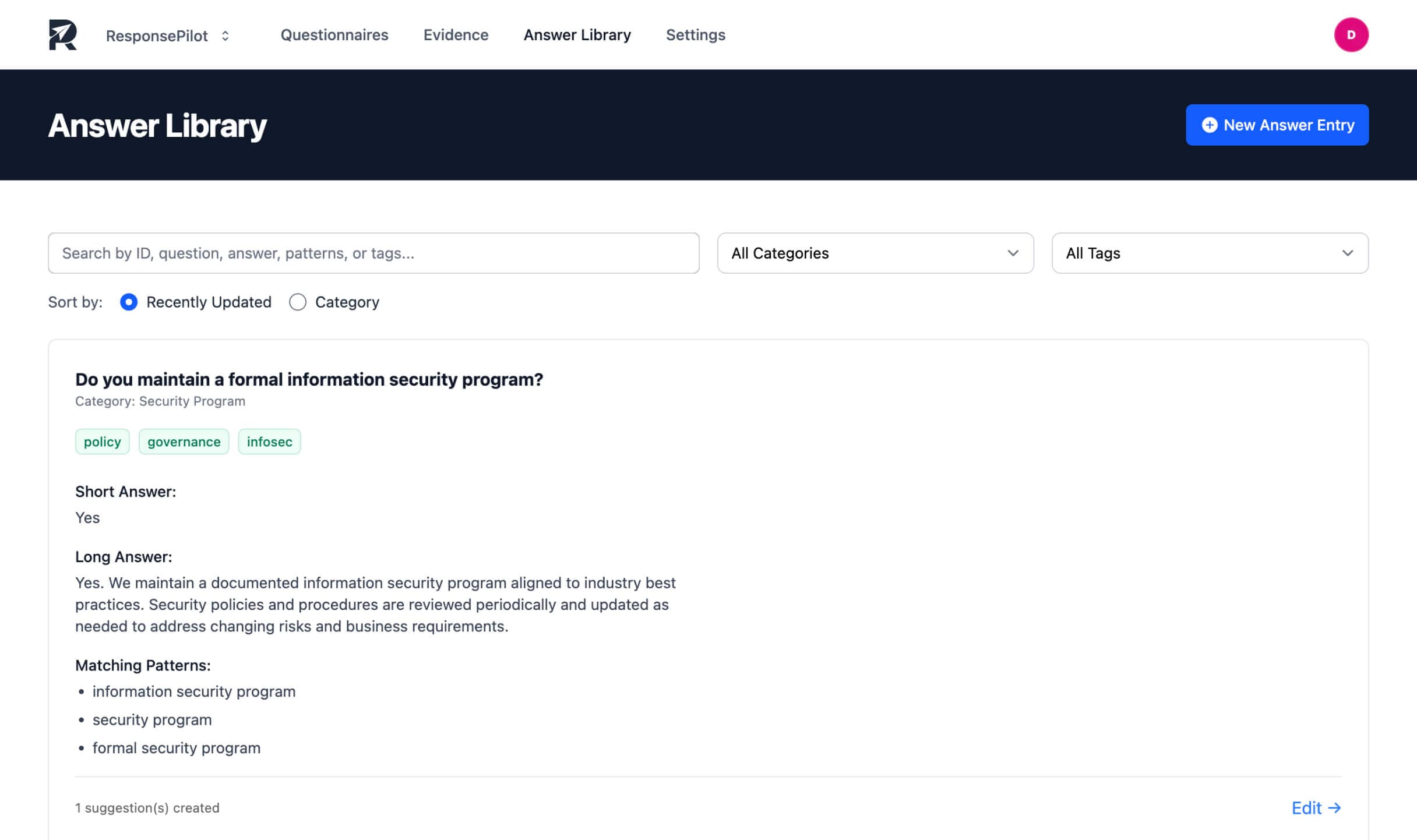
- Your approved answer library
- Your uploaded documentation
That means responses aren't guessed. They're grounded in answers you've already vetted and the policies you've already written.
You review, approve, or edit. Every approved response strengthens your answer library for the next questionnaire.
Evidence is built-in
Security reviewers don't just want text. They want confidence.
When a question about encryption or incident response appears, ResponsePilot links the suggested answer back to relevant documentation. This keeps responses consistent and defensible.
When you export, you get:
- The completed spreadsheet, formatting preserved
- A clean evidence packet mapping answers to supporting documents
- No broken columns. No reformatting issues. No awkward back-and-forth because a template changed.
It's focused on one problem
ResponsePilot isn't a full GRC platform. It doesn't replace your compliance stack. If you already use Vanta, Drata, Secureframe, or maintain your own documentation, that's great.
Those tools track readiness.
ResponsePilot removes the friction of finishing the spreadsheet itself. It's narrow by design. It solves the part that actually slows down deals: turning a raw vendor questionnaire into a clean, defensible submission.
Who it's for
ResponsePilot is especially useful for SaaS teams in the 10-50 employee range. You're mature enough to pass security review, but not large enough to have a dedicated compliance department handling paperwork.
If questionnaires land on your Sales Engineer, CTO, or founder, you'll feel the difference quickly.
It's also valuable for consultants managing multiple client reviews. When you're filling out variations of the same spreadsheet repeatedly, even small efficiency gains compound.
The goal
The goal isn't to automate compliance.
It's to:
- Save meaningful time
- Keep answers consistent
- Reduce contradictions
- Attach evidence cleanly
- Move security reviews forward faster
- Close deals quicker
Security questionnaires are part of modern B2B infrastructure. You can't avoid them. But you don't have to treat them as emergencies.
Early access
ResponsePilot is live, and I'm working closely with a small group of early teams. If you want to try it, bring a real questionnaire - the kind you actually receive from customers. We'll run it through together and see how much time it saves.
If it removes friction, great. If not, I want to know why.
Security questionnaires aren't going away, but rewriting the same answers over and over again doesn't have to be the default anymore.